
The Language Every Student Understands: The Language of Belonging

Istanbul International Community School
Published:
Differentiation is not only a set of strategies, it is the language that helps us reach every student’s heart.
In 2018, my younger brother died in a car accident.
At the time, I was teaching a grade 9 Spanish class in Istanbul. I didn’t tell my students what had happened, but they knew. The next class, I walked in and tried to act as if nothing had changed.
The room was silent. Then, one by one, they stood up and gathered around my desk.
They had baked a cake. They brought flowers, little plants, and chocolates. And they gave me a card they had made by hand, decorated with icons from the Mexican Day of the Dead. Every one of them signed it, and they wrote in Spanish:
“Lamentamos su pérdida. De: tu clase de español. Te amamos.”
We are sorry for your loss. From: your Spanish class. We love you.
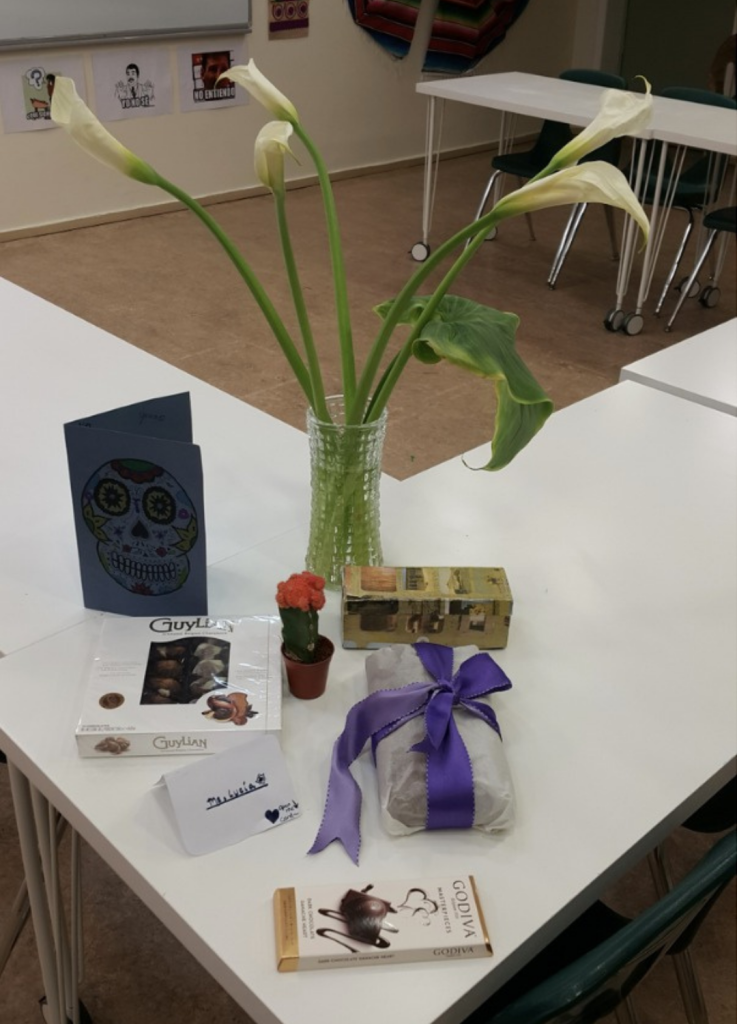
These were teenagers writing in a language that was not their own. They used my culture to reach my heart, choosing symbols from a tradition I had taught them, not because it was on a test, but because they wanted to connect with me as a human being.
That is what education is supposed to do.
Education fills students with knowledge. A teacher shapes them into people who are wise, who know how to use that knowledge in the right context, at the right time, and in the right manner
You have moments like this too
Close your eyes for a second and remember it.
Maybe it was the lesson where the whole room leaned in. Maybe it was the quiet student who finally raised a hand. Maybe it was the one everyone had given up on, who looked at you one afternoon and you could see it in their face: someone believes in me.
You remember how that feels. That feeling is why you became a teacher.
Doesn’t it sound like a dream to have every lesson feel like that?
We are caring educators, but our workload can feel overwhelming. We have little energy left to see every child, and even less to prepare differentiated materials or inclusive resources. Yes, we all know good UDL strategies, and we want to apply them, but time is a big constraint.
We are not imagining it. In the OECD’s latest international survey of teachers, about half named excessive administrative work as a source of stress.
Right support makes belonging visible
But what if time was no longer the obstacle? Let me give you one example from my own classroom.
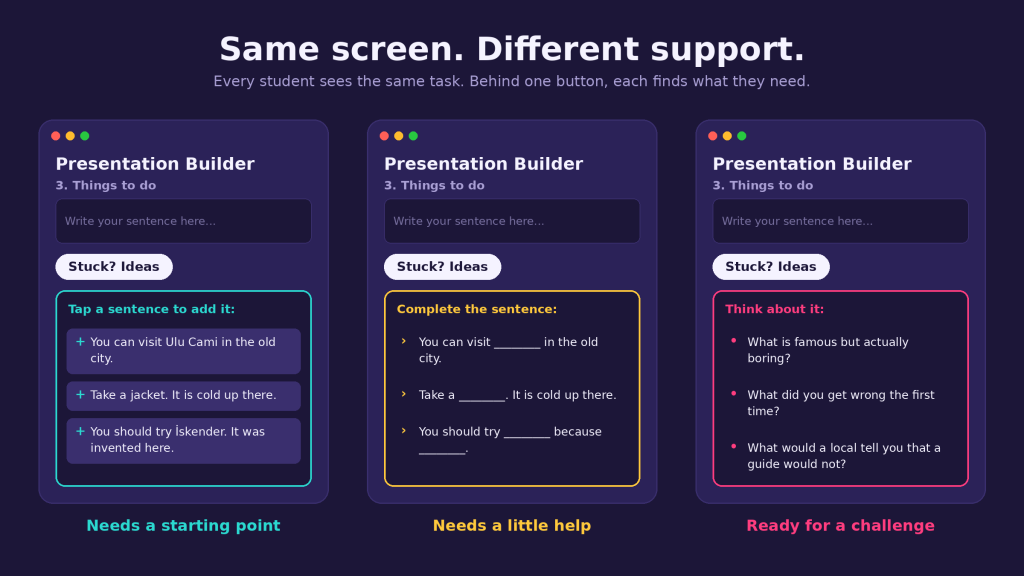
My students had just come back from their class trip, so I asked them to create a presentation to attract young tourists to a city. The task was relevant because it connected to something they had just lived. Same task, very different needs. Some write beautifully but freeze when they speak. Others speak easily but struggle to read.
With AI, I built a planning tool where every student saw exactly the same screen: the same sections, the same boxes, the same buttons. But behind one button, “Stuck? Ideas,” each student found something different. One found complete sentences he could tap into place and then make his own. Another found sentences with gaps to complete. The strongest writers found harder questions to push their thinking further.
Nobody could see the difference. Nobody was the student with the easy worksheet. Everyone was simply doing the task.
They wrote their own sentences first. Then they wrote their own instructions for an AI tool to design the slides. Their last job was to find one thing the AI had changed or got wrong. When I tested it with my own model, it proudly labeled İskender, a famous Turkish dish, on a picture of a plate of tomatoes. AI is a brilliant assistant. It is not the teacher.
They loved it. One student enjoyed it so much that he jumped in to participate without being asked.
The scaffolding was invisible, but the care was not. Each student received exactly what they needed, and no one was exposed. That is why they could participate: they felt safe. And when students feel safe, they don’t hold back. They try.
Linguist Stephen Krashen named this decades ago: the affective filter. Anxiety works like a filter that blocks new language from getting in. Lower the filter, and learning flows.
Differentiation is a language
Scaffolds, sentence frames, tiered tasks, and graphic organizers are real tools. But they are the grammar and vocabulary of something bigger. On their own, they are a phrasebook in the hands of someone who can pronounce the words but doesn’t know what they mean.
What students are listening for, in every task we hand them, is the message underneath:
- I see you.
- I made this for you.
- You are worth my effort.
When differentiation is driven by care, it produces transformation for the students and satisfaction for the teacher.
Research agrees. Students who feel they belong at school are more engaged, and the latest PISA results show that greater teacher support goes hand in hand with a stronger sense of belonging.
So what if every lesson could feel like that?
This is where I have good news.
I used to be an AI skeptic, but I decided to give it a fair hearing. I spent weeks learning how to work with it properly. What used to take me two hours started taking thirty minutes, then fifteen, then ten. I am not alone: in a 2025 Gallup survey of U.S. teachers, those who used AI weekly reported saving almost six hours a week.
But the speed was not the real gift. The gift was what I did with the time.
AI can carry the building, applying UDL strategies, Visible Thinking Routines, best practices, learning support specifications, and much more. That leaves me free for the work no machine can do. Noticing who went quiet. Knowing who needs a snack before he can think. Designing a lesson with one specific heart in mind.
AI builds the road. You walk with your students down it.
Here are five things you can try on Monday:
- Protect your students. Use the AI platform your school has approved and follow your school’s AI policy. If there isn’t one yet, advocate for one. Student data is protected by law, such as GDPR in Europe and KVKK in Türkiye.
- Observe your students. Talk to them. Connect with them. You already know them academically. Now you also get a sense of their emotional and social context.
- Take that context to the AI. Start with the student, not the content. Before you ask AI for anything, tell it who is in your room. The one who went quiet this term. The one who performs on paper but has no friends. Context is everything. You don’t need names or personal data such as surnames, ID numbers, religion, or race. Focus on academic, emotional, and social needs.
- Use it as a thinking partner. Share your ideas and simply ask: “I need to teach this. What do you think, and what am I missing for you to complete this task effectively?”
- Review and approve. You are the teacher. The final decision is always yours.
You will be surprised how much your critical thinking and creativity grow with AI while your heart stays with your students. That is why none of this replaces you. It gives you back to your students.
Back to the card
My grade 9 students did not bake that cake because I had differentiated well. They did it because they knew they mattered to me. The differentiation was simply the language through which that care became visible.
Every student who walks into your classroom carries a question they will never ask out loud: Am I worth your effort?
You remember what it feels like when the answer is yes. Now imagine giving that answer in every lesson.
It’s possible. Go get them!
Further reading
CAST. (2024). Universal Design for Learning Guidelines version 3.0. https://udlguidelines.cast.org
Goodenow, C. (1993). The psychological sense of school membership among adolescents: Scale development and educational correlates. Psychology in the Schools, 30(1), 79-90.
Krashen, S. D. (1982). Principles and practice in second language acquisition. Pergamon.
Marmolejo Jiménez, L. (2026). The differentiation trap: From framework to belonging. Self-published. ISBN 9786250040812.
OECD. (2025). Results from TALIS 2024. OECD Publishing.
OECD. (2026). PISA 2025 results (Volume I): Future-ready students. OECD Publishing.
Ritchhart, R., Church, M., & Morrison, K. (2011). Making thinking visible: How to promote engagement, understanding, and independence for all learners. Jossey-Bass.
Walton Family Foundation. (2025, June 25). The AI dividend: New survey shows AI is helping teachers reclaim valuable time. https://www.waltonfamilyfoundation.org/the-ai-dividend-new-survey-shows-ai-is-helping-teachers-reclaim-valuable-time
Author
Lucía Marmolejo Jiménez, M.Ed., is an IB English B teacher and EAL facilitator at Istanbul International Community School and the author of The Differentiation Trap: From Framework to Belonging. She is also the founder of Educator Companion, an AI platform that helps teachers differentiate.